We chose Spain for our project, and in this article, we will explain why and outline our ecological goals.
Before embarking on this journey, we lived in Germany, which is why we use it as a point of comparison.
Spain, located on the Iberian Peninsula, is approximately 40% larger than Germany but has over 40% fewer citizens. According to World Bank statistics, about 82% of Spain’s population lived in urban areas in 2023, meaning 4 out of 5 people are concentrated in cities and along the coasts.
What brought us to Fuenlabrada de los Montes in Extremadura?
Finding an apartment in Spain was challenging after a year and a half without a paycheck. Additionally, we didn’t have the necessary paperwork or a Spanish bank account to rent and reside in Spain. Fortunately, an older woman in Fuenlabrada de los Montes took a chance on us. This brought us to a region with the lowest population density and minimal summer rainfall. Extremadura has large reservoirs for drinking water, agriculture, and hydroelectric power. However, most streams dry up in the summer, and the landscape turns from green to yellow by late spring.
Spain: Size and Population
| Size of Country | 502 654 km² (Germany: 357 596 km2) |
| Population | ~48 million (Germany: ~84 million) |
| Population/km² | 94,4 (Germany: 234,3) |
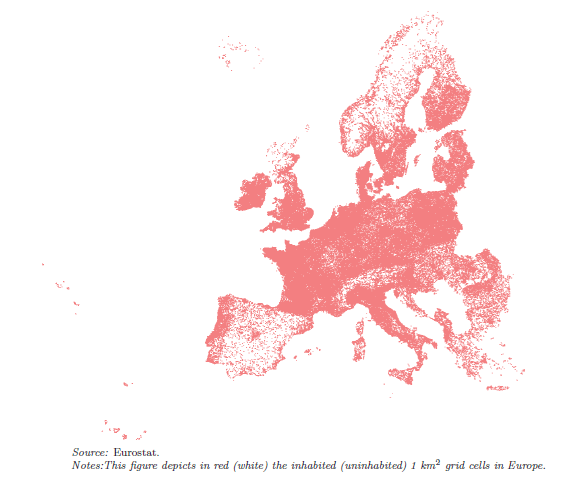
To provide context, we’ll refer to figures from a paper published by Banco de España titled “The Spatial Distribution of Population in Spain: An Anomaly in European Perspective”. The first figure illustrates inhabited areas in red and uninhabited areas in white.
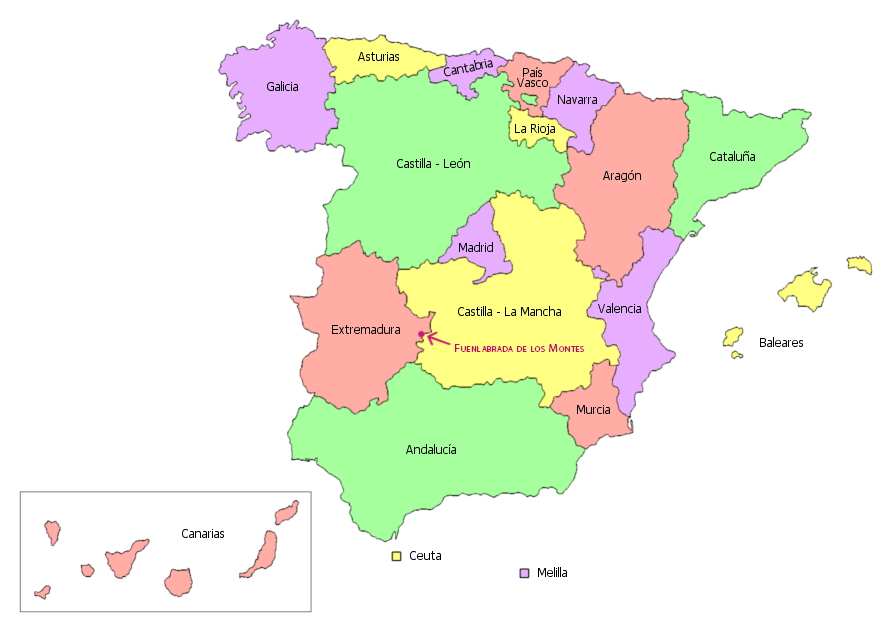
Autonomous Communities of Spain
To understand our journey through Spain, it’s helpful to familiarize oneself with its Autonomous Communities and Provinces. Here’s a map for reference. See figure 2.
The last part of our journey began near Irun, entering into the Autonomous Community of País Vasco. País Vasco is located in the north of the Pyrenees with a short border with France and stretches along the northern Atlantic coastline. Continuing southward, we crossed through Cantabria, Asturias, and Galicia, where we concluded our long-distance walk. Northern Spain experienced substantial rainfall during our summer there.
After departing from Finisterre in Galicia, we traveled via Madrid to Extremadura. Fuenlabrada de los Montes, where Yannick stayed until Diana Luz returned from the US, is located in eastern Extremadura. Specifically, it is southwest of Madrid, north of Badajoz, and east of Ciudad Real in Castilla-La Mancha. It is also relatively close to the border with Andalusia.
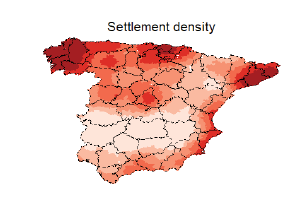
The provinces with the lowest settlement density include Badajoz and Cáceres in Extremadura, Ciudad Real and Albacete in Castille-La Mancha, and Córdoba and Jaén in Andalucia.
Settlement density refers to the number of inhabitants per square kilometer, indicating sparsely populated areas.
In contrast, Galicia and País Vasco autonomous communities, along with the province of Barcelona, have the highest settlement density. Additionally, the metropolitan area of Madrid in the center of Spain exhibits high settlement density due to its concentrated population.
Why did we choose Spain for the Project?
Spain faces the most urgent need among European nations for interventions against desertification, erosion, soil degradation, and for promoting soil health and water conservation. It is evident that humans tend to avoid confronting the problems they have created, a trend starkly observed in Spain where rural exodus began in the 1960s, resulting in over 80% of the population now residing in urban areas.
We chose Spain for our project because we believe it is crucial to tackle challenges where they are most pressing. Many regions of Spain, particularly in the southern half, are experiencing shifts in precipitation patterns, increased erosion risks, and soil degradation.
Fortunately, there are solutions. For us, running away is not an option.
Ecology related Project Goals
In this section of the article, we focus on the ecological goals of the project. Our primary objective upon purchasing land in a desertification-risk area is achieving water autonomy. To accomplish this, we are implementing measures to store water through various methods, enhancing soil health, and creating conditions conducive for the growth of a native forest.
Water Retention System
- Problems: Quick and strong rains in winter and lack of rain in summer
- Solution: Catch and store rain for the summer
- How to solve: Water retention system (ponds, swales, gabions etc.)
Soil Health
- Problems: Intensive agriculture (fertilizers, pesticides, herbicides etc.), drought and changed precipitation patterns
- Solution: Adopt regenerative agricultural principles and practices
- How to solve: Minimizing tillage, increasing crop diversity, using cover crops, rotating crops and adding organic amendments
Building
- Problem: No houses, no accomodation
- Solution: Renovating ruins, building houses/cabins
- How to solve: Using traditional building materials and techniques, building tiny houses, earth ships, hobbit houses, earth-sheltered houses
Food Production
- Problem: Food has to be bought, chemically contaminated
- Solution: Grow our own food without chemicals
- How to solve: Regenerative agriculture, permaculture, aquaponics
Workshop, Machines and tools
- Problem: We came to Spain with 25 kg each in our backpacks
- Solution: Building and equipping a workshop and a shed
- How to solve: we don’t know yet. We can efford some basic machines and tools and then we need your help.
From this article, you should now understand, at least a little bit, why we are in Spain and what our ecological goals for the project are.
However, this is just the beginning. We see it as laying the foundation for the core objectives of the project. If you are interested, more information on the main project can be found here.
Sources:
- https://www.bde.es/f/webbde/SES/Secciones/Publicaciones/PublicacionesSeriadas/DocumentosTrabajo/20/Files/dt2028e.pdf ↩︎
- https://w.wiki/Aieq (Licensed under: Creative Commons Attribution-Share Alike 3.0 Unported; changed: Fuenlabrada de los Montes) ↩︎
- https://www.bde.es/f/webbde/SES/Secciones/Publicaciones/PublicacionesSeriadas/DocumentosTrabajo/20/Files/dt2028e.pdf ↩︎

 Culture by Design
Leave a comment