In the vast and intricate world of biological sciences, the concept of autopoiesis stands out as a profound explanation of how living systems sustain and perpetuate themselves. Coined by Chilean biologists Humberto R. Maturana and Francisco J. Varela in the early 1970s, autopoiesis offers a lens through which we can understand the self-organizing nature of life, and ourselves.
Human beings are autopoietic beings.
Humberto R. Maturana
Let’s delve deeper into the origins, meaning, and implications of this fascinating term.
The Origins of Autopoiesis
The term “autopoiesis” is derived from Greek roots: “auto-” meaning “self” and “poiesis” meaning “creation” or “production.” Maturana and Varela introduced this concept in their quest to describe the unique creative qualities that distinguish living beings from non-living entities. They sought to explain how living organisms are capable of maintaining their own structures and functionalities through internal processes, rather than relying on external influences.
Why is this important for our project?
This is important for our project because many of us tend to believe they are products of their environments. As the works of Maturana and Varela suggest this is not true. Yes, we are influenced by the environments in which we operate. And no, we are not products of our environments. We, as living beings, have the natural ability for autopoiesis, for self-creation and -maintanance.
We can apply our inherent abilities to self-create to actualize, evolve, and survive in our environments in new, more harmonic ways! If we do, step by step, what is necessary! And this is an urgent realization for each one of us, before it is too late. Because there are forces at work which want to make us believe we are helpless and powerless biological machines determined by the “outside world”.
What Does Autopoiesis Mean?
At its core, autopoiesis refers to the ability of a living system to continuously produce and regenerate its own components, thus maintaining its structure, identity, and functionality over time. This self-sustaining process is what allows living organisms to actualize, evolve, survive in their environments. This refers not only to the biological dimension of human’s existence but also to the mental dimension.
The key aspects of autopoiesis are:
Self-Production: Autopoietic organisms are characterized by their ability to generate their own parts through internal processes. For example, cells produce proteins and other molecules necessary for their survival and function.
Self-Maintenance: Living systems maintain their integrity and boundaries through continuous regulation and repair. Cells, for instance, have mechanisms to repair damaged DNA and maintain membrane integrity.
Autonomy: Autopoietic systems operate independently, controlling their own processes and maintaining a distinct boundary between themselves and their environment. This autonomy allows for the emergence of individuality and identity in living organisms.
Continual Renewal: The components of a living system are constantly being recycled and renewed. This dynamic equilibrium ensures that the organism can adapt to changing conditions while preserving its core identity.
Living Systems and Autopoiesis
Living systems, ranging from single-celled organisms to complex multicellular beings like humans, exhibit autopoietic properties. These systems are characterized by their ability to self-organize, adapt, and evolve in response to internal and external stimuli. Let’s explore some examples of autopoiesis in living systems:
Cells: The fundamental units of life, cells are quintessential autopoietic systems. They continuously synthesize and degrade proteins, lipids, and nucleic acids to maintain their structure and function. Cellular processes like mitosis and meiosis ensure the reproduction and renewal of cells, supporting growth and development.
Organisms: Multicellular organisms, such as plants and animals, are composed of numerous interacting cells that work together to sustain life. These organisms exhibit autopoiesis at a higher level of complexity, with specialized systems (e.g., the immune system) that protect and repair the organism, ensuring its survival and adaptation.
Ecosystems: While not autopoietic in the strictest sense, ecosystems demonstrate a form of collective self-organization and maintenance. The interactions between various species and their environment create a dynamic balance that sustains the ecosystem as a whole.
Implications of Autopoiesis
The concept of autopoiesis has far-reaching implications beyond biology. It has influenced fields such as systems theory, cognitive science, and artificial intelligence, providing a framework for understanding complex, self-organizing systems.
Moreover, autopoiesis challenges us to rethink our understanding of life and living systems. It emphasizes the inherent creativity and autonomy of living beings, highlighting the intricate dance between order and chaos that defines existence.
Conclusion
Autopoiesis, with its roots in the Greek words for “self” and “creation, production” encapsulates the essence of life as a self-sustaining, self-organizing phenomenon. From the microscopic world of cells to the macroscopic interactions within ecosystems and even social systems, autopoiesis provides a powerful framework for understanding how living systems produce, maintain, and renew themselves. As we continue to explore the mysteries of life, the concept of autopoiesis will undoubtedly remain a cornerstone of our quest for knowledge.
Why is this important for our project?
This is important because it provides clarity about the value of our bodies and minds. This knowledge gives an understanding why supressing body, mind or soul in favor of another is not a goal-oriented path of evolution in general, and involution in particular.
The term “involution” describes the inner evolution of living beings. For example expanding consciousness and knowledge.
To understand that human beings are naturally given the ability to change themselves is inevitable for our project because at its core it is about change, about human beings changing themselves. In an environment specifically designed to promote these kind of change processes.
As a human being I need to understand the natural features I was given when I was born into a human existence. Autopoiesis lays the foundation for the understanding that each one of us as a living system creates its reality in an infinite recursive process (structural coupling). To further understand this we need to know what Humberto Maturana wrote about “Objective Reality”.
Is there an Objective Reality?
Humberto Maturana has a unique perspective on objective reality that is deeply intertwined with his theories of autopoiesis and cognition. According to Maturana, objective reality, as traditionally conceived, does not exist independently of our perceptions and cognitive processes.
Here are some key points that elucidate Maturana’s views on objective reality:
Reality as a Construct
Maturana posits that what we consider reality is essentially a construct of our cognitive processes. He argues that we cannot access an objective reality directly; instead, our understanding of the world is mediated through our sensory and cognitive systems. This means that our perceptions and experiences shape our reality, and there is no singular, objective reality that exists independently of our interactions with “the world”.
The Role of the Observer
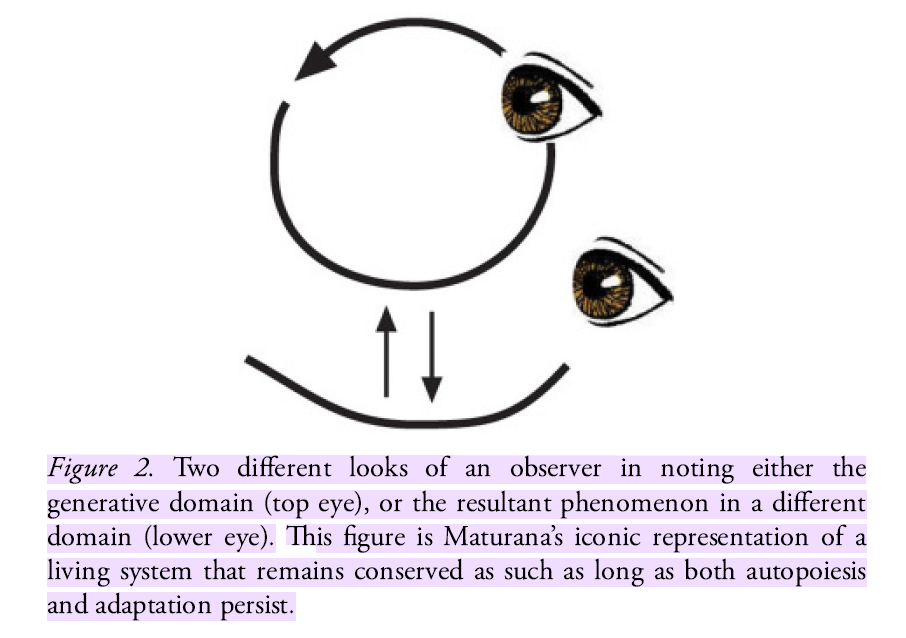
Central to Maturana’s philosophy is the idea that the observer plays a crucial role in the construction of reality. He asserts that every observation is dependent on the observer’s cognitive framework, which includes their sensory apparatus, past experiences, and contextual factors. Therefore, different observers may construct different realities based on their unique cognitive frameworks. This leads to the conclusion that reality is inherently subjective and varies from one individual to another, and even from the perspective chosen for observation.
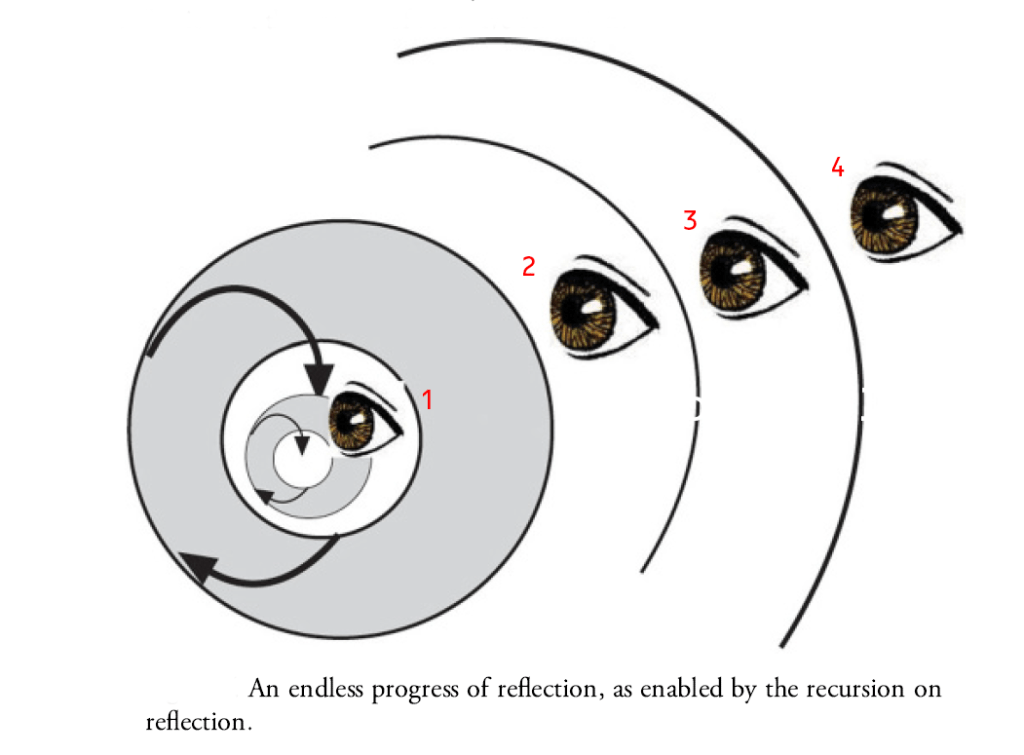
The figure beneath shows four different perspectives an observer can choose. There is the original perception (1), the reflection (2), the reflection of the reflection (3) and the reflection of the reflection of the reflection (4). This is natural human capacity which one needs to understand itself and its environment.
The Biology of Cognition
In his work on the biology of cognition, Maturana explores how living systems, particularly humans, perceive and understand their environment. He contends that cognition is a biological process that is fundamentally linked to the organism’s structure and functioning. As organisms interact with their environment, they generate and maintain a coherent world that is meaningful to them. This process of sense-making is what constitutes their reality.
The following video can help what is going on with sense-making:
For those who are interested in more input to this topic you can find a couple more talks on this topic when you type in “The War on Sensemaking”. When I do not make sense myself other forces will do it for me.
Structural Coupling
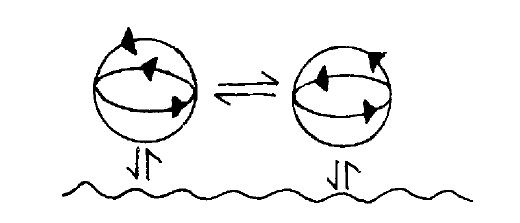
Maturana introduces the concept of structural coupling to explain how organisms and their environments are mutually influential. Structural coupling refers to the ongoing interactions between an organism and its environment, where both are continuously adapting to each other. Through these interactions, organisms develop a coherent understanding of their world, which is specific to their particular mode of living. Thus, reality is seen as a dynamic and co-constructed phenomenon rather than a fixed and objective entity.
In the following figure you see two living systems (two circles) with neural networks (oval circles in the circles). The wave line underneath represents the environment (or niche) in which the two living systems operate. The arrows pointing from the living system to the environment and from the environment to the living system represent the reciprocal influence between living systems and their environment. The arrows pointing from living system to living system represent the structural coupling of two living systems.
Implications for Knowledge and Science
Maturana’s views challenge traditional notions of objectivity in science and knowledge. He suggests that scientific knowledge is also a construct of human cognitive processes and is influenced by the observer’s perspective. This implies that scientific theories and models are not objective truths but rather useful tools for navigating and making sense of our experiences. Maturana advocates for a more reflexive approach to science, one that acknowledges the role of the observer and the context in the construction of knowledge. This is coherent to realizations in quantuum physics.
Summary
In summary, Humberto Maturana’s perspective on objective reality is that it does not exist independently of the observer’s cognitive processes. Reality is constructed through the interactions between living systems and their environments, and it is inherently subjective. This view has profound implications for our understanding of knowledge, science, and the nature of existence itself, emphasizing the importance of acknowledging the observer’s role in shaping reality.
Why is this important for our project?
When one understands that reality is a construct by its cognitive processes it becomes less heavy and “the outside” becomes an integral part of its being. The separation which is talked about in the spiritual films we recommend to watch dissolves. When the separation ends one feels whole and in touch with what surrounds one’s self.
As quantuum mechanics suggests the observer plays a crucial role in the construction of reality so does the philosophy of Maturana. When I understand this I am offered the opportunity to expand to my whole potentials which can only be accessed after I realized the inherent subjectivity of reality. Why? Because we are unique beings and have unique sets of potentials.
From his work on the biology of cognition I can learn why it may be difficult to change my structure and functioning. It is difficult because I do my best to mainain a coherent world that is meaningful to me. If that world is a world of total separation it takes time to change my structure and functioning. It becomes even more difficult when the environment does not reflect the necessary changes.
Changing is a slow, step-by-step process and is approached in our current world in the wrong way. Many want change but they want it now. They tend to hope they could change from one minute to the next. And that leads to nowhere. I have to accept how change works and play by its rules. Step-by-Step. This is how we change ourselves and at the same time our realities!
After reading and understand what is written above I should have a feeling for why this is important for the project. Humberto Maturana’s works provide a framework for rethinking ourselves and our relationships to the environments. These concepts and descriptions provide some fundamental assumptions about one’s self and our environment.
They can serve as a bottom-up approach towards a new humanity.
Exploring Autopoiesis and the Nature of Reality
In our exploration of autopoiesis and the nature of reality, we have delved into the profound insights offered by Chilean biologist Humberto Maturana. Autopoiesis, the term coined by Maturana and Francisco Varela, describes the self-creating and self-maintaining nature of living systems. This concept highlights how organisms continuously produce and regenerate their own components, ensuring their autonomy and continual renewal. From the cellular level to complex multicellular organisms, autopoiesis underscores the dynamic, self-sustaining processes that characterize life.
Maturana’s perspective on objective reality further enriches our understanding. He challenges the traditional notion of an independent, objective reality, positing instead that reality is a construct of our cognitive processes. According to Maturana, our perceptions and experiences shape our understanding of the world, leading to a subjective reality that varies from one individual to another. This view emphasizes the role of the observer in constructing reality and suggests that scientific knowledge is also influenced by the observer’s perspective.
By integrating the concepts of autopoiesis and Maturana’s views on reality, we gain a holistic understanding of how living systems not only sustain themselves but also create their own realities through their interactions with their environments. This framework invites us to reconsider our approach to knowledge and science, acknowledging the intrinsic connection between the observer and the observed. In doing so, we embrace a more nuanced and reflexive perspective on life and reality, one that recognizes the complexity and interdependence of all living systems.
Why is this important for our project?
This is important for the project because it aims to invite, inspire and empower its participants to fully recognize their own potentials. That is one of the central goals of the project because it becomes more and more obvious that there are political and economical forces trying to convince people to be useless, helpless and powerless, and that the only way forward is obeying to their ideology.
In the following video Humberto Maturana describes the concept of Autopoiesis and the Biology of Cognition.
Because the topic described is not easy to understand there is a German translation for the german speakers:
Further Reading:
Humberto R. Maturana – Biology of Cognition (1970)
Humberto R. Maturana – Autopoiesis and Cognition: The Realization of the Living (1979)
Humberto R. Maturana & Francisco J. Varela – The Tree of Knowledge: Biological Basis of Human Understanding (1984)
Humberto R. Maturana & Kurt Ludewig – Conversations with Humberto Maturana: Questions to Biology, Psychotherapy and “The Tree of Knowledge” or: The Questions I always wanted to ask (1992)
 Culture by Design
Leave a comment